

MiddleWeb's February Articles
Educators everywhere are caught up in the AI buzz. Us, too! There's also math, STEM, accelerated learning, fun activities, and a surprising way to get kids to slow down, observe, and wonder.
Who can keep up with anything these days?! Once a month we’re making it easy for MiddleWeb Substack subscribers by sending you brief descriptions of last month’s new MiddleWeb.com articles and reviews – written (as always) by educators who are doing the work. Just click on a title to check it out!
Articles
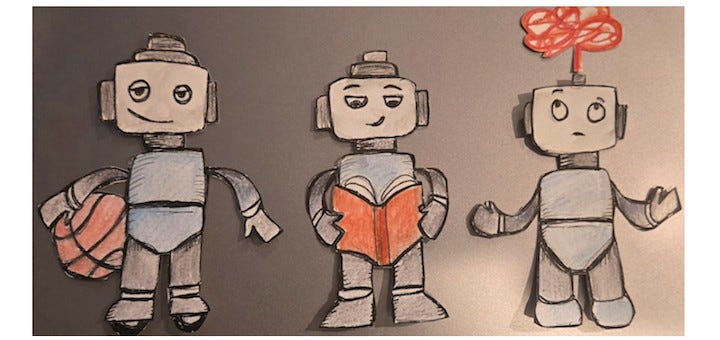
Would You Let a Robot Do That for You?
As AI becomes omnipresent, it can be tricky to say exactly what “doing your own work” means or why you might prefer to do it yourself. Laurie Hornik shares the day she led her 7th graders in thinking about what they’d be willing to turn over to AI. Cue the robot basketball players.
Accelerate or Remediate? Teachers at the Controls.
Acceleration means providing grade-level instruction with strategic scaffolds and just-in-time support. It means believing all kids can access rigorous content with the supports you can build. And it’s a decision entirely within your Circle of Control, says Dr. Sonya Murray.
What If Every Teacher Taught Media Literacy?
More state legislatures are developing media literacy policies in response to debates over student phone use, social media restrictions, and artificial intelligence. But are they committed to supporting programs that engage all teachers in opportunities to teach media literacy?
5 AI Do’s and Don’ts for Today’s School Leaders
It’s becoming increasingly critical for educators to understand both the benefits and the challenges of using artificial intelligence. Ron Williamson and Barbara Blackburn share 5 ways to make AI most helpful to school leaders, and 5 tasks to handle without much if any AI involvement.

Live Webcams Help Kids Slow Down and Wonder
Helping middle school students learn how to slow down, notice, and wonder may be one of the most important things we do. Kendra Cameron-Jarvis shows how teachers can use live worldwide webcams to spark small observation routines that build both attention and global awareness.
Mining Social Media for Fun Learning Activities
If you’re a teacher who spends time online, your algorithm probably sends you various teaching hacks from teacher influencers. Megan Kelly was curious to see if these teaching tips actually translate to the real world. Here are some of her recent favorite fun discoveries.
How Collective Teacher Efficacy Impacts Literacy
Consider adopting Collective Teacher Efficacy to meet the learning needs of all of your students. Laura Robb shows how teacher teams can collaborate to develop scaffolds and modifications that offer students the support and hope they need to achieve challenging learning goals.
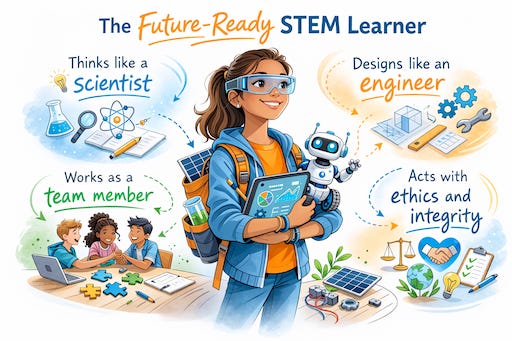
Prepping STEM Kids for Their AI-Driven Future
When STEM learning blends innovation with empathy, critical thinking with collaboration, and technology with ethics, your students will gain critical skills that can prepare them to lead, adapt, and shape an AI-driven world that’s still unfolding, writes STEM expert Anne Jolly.
Bringing a Lab Mindset to Group Work in Math
What if we approached math as an experimental subject and encouraged students to work together to solve problems using a “lab mindset”? Fifth grade teacher and NBCT Kathie Palmieri has been exploring science and math standards with the power of collaborative learning in mind.
Teaching Discernment in Student/AI Interactions
Sharpening our reasoning powers about when and how to engage with artificial intelligence will serve us and our students well as we navigate whatever the future brings, says Brett Vogelsinger. He offers two lesson ideas we can use to model quality reasoning during AI interactions.
Reviews
A Principal’s Playbook for Conflict Management
Conflict in schools isn’t abstract – it’s lived daily. Offering tools, examples, and mindset shifts, veteran school leader Jen Schwanke helps principals understand and manage conflict and lead beyond it with clarity, empathy, and a steady hand, writes principal Dennis Schug.
Teaching for Instructional Equity and Cognitive Justice
Zaretta Hammond’s Rebuilding Students’ Learning Power examines the cultivation of “cognitive justice” to ensure that every student, especially those from historically marginalized groups, experiences the full rigor, challenge and coaching necessary to develop as an independent, powerful learner, says Melinda Stewart.
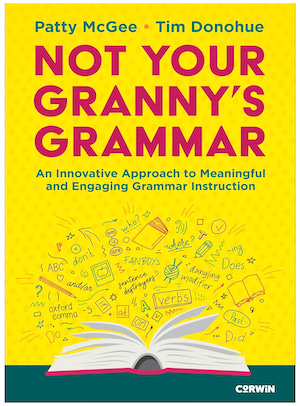
An Innovative Approach to Grammar Instruction
Not Your Granny’s Grammar: An Innovative Approach to Meaningful and Engaging Grammar Instruction offers a fresh, engaging, and practical approach to grammar rooted in authentic writing practice. It’s well organized to guide teachers through the philosophy, structure, and application of a comprehensive grammar study, writes NBCT Kathie Palmieri.
Creating a Competency Based Learning System
Deeper Competency-Based Learning provides educational leaders, teachers and policy makers both the vision and the tools necessary to move from traditional grading and assessment toward a competency model that accurately reflects student mastery, writes coach Kathee Lamberies.